Home
›
Pre-Health Pathways
› Pre-Med Clinical Hours
How Many Clinical Hours for Med School? The Pre-Med Clinical Experience Guide
What counts as clinical experience, how many hours medical schools expect, how shadowing differs, and the fastest way for Connecticut pre-meds to get paid, patient-facing hours.
Questions? Call (203) 391-6766, Monday–Friday, 8am–5pm.
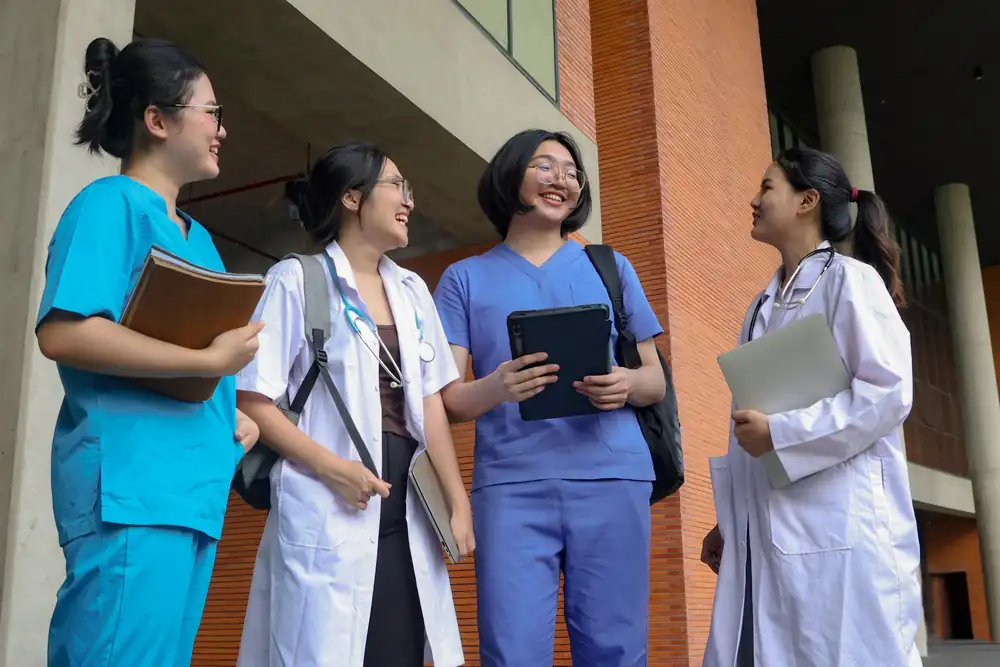
Earn patient care hours in as little as 2 weeks CNA and Phlebotomy are the fastest ways to start logging PCE hours for PA, medical or nursing school.
What Counts as Clinical Hours for Med School?
Clinical experience is time spent interacting with patients in a healthcare setting, where you see what caring for people really involves.
Usually counts
- Certified nursing assistant (CNA)
- Phlebotomist
- Patient care technician / ER tech
- EMT
- Medical scribe
- Clinical medical assistant
- Hospice or hospital volunteering with direct patient contact
Usually doesn't count as clinical
- Shadowing (logged separately; you observe, you don’t interact)
- Lab or bench research
- Front-desk or billing work
- Pharmacy tech work without patient care (valuable healthcare exposure, but rarely “clinical”)
- Non-patient-facing volunteering
Your duties matter more than your job title. Describe your patient contact clearly on AMCAS or AACOMAS.
How Many Clinical Hours Do You Need for Med School?
There’s no official number. The AAMC doesn’t set a minimum, and most medical schools don’t publish one. What they look for is depth and commitment over time.
Many pre-med advisors suggest a floor of roughly 100 to 150 clinical hours, which is about 2 to 4 hours a week for most of a school year. Competitive applicants often have many more, especially those who worked a clinical job for a year or longer.
The AAMC stresses “depth of experience and a longitudinal commitment.” A year of steady weekend shifts as a CNA tells a stronger story than a two-week summer program.
Connecticut’s medical schools don’t publish an hour count either. UConn School of Medicine, for example, asks you to highlight your clinical experience in its supplemental application.
What the AAMC Says About Clinical Experience
The AAMC names five alternatives: certified nursing assistant (with 4 to 16 weeks of training), hospice volunteer, volunteer EMT, medical scribe and caretaker. Each gives you real patient interaction, which is what admissions committees want to see.
For pre-meds, that makes CNA one of the most efficient choices: short training, lots of patient contact and paid shifts that fit around classes and MCAT prep.
Pre-med? Start with CNA
- 104 hours · $1,662.95 · 6 CT campuses
- Theory online at your own pace
- Day or evening labs at 6 CT campuses
Shadowing vs Clinical Experience: What's the Difference?
| Shadowing | Clinical experience | |
|---|---|---|
| What you do | Observe a physician at work | Interact with and help care for patients |
| What it shows | You understand what doctors do day to day | You’re comfortable with patients and committed to care |
| Typical setting | Clinic or hospital, alongside a doctor | Hospital unit, ER, nursing home, lab, ambulance |
| Does it count as clinical hours? | No, it’s logged separately | Yes |
| Paid? | No | Often, as a CNA, phlebotomist, PCT or scribe |
The AAMC doesn’t set a shadowing minimum either. Many applicants shadow physicians in more than one specialty.
Earn patient care hours in as little as 2 weeks CNA and Phlebotomy are the fastest ways to start logging PCE hours for PA, medical or nursing school.
How to Get Clinical Hours for Med School
Choose a patient-facing role
CNA, phlebotomy or PCT give you hands-on contact from day one.
Get certified early
Train over winter break or summer of freshman or sophomore year.
Work consistently
A few steady shifts a week beats a burst of hours right before you apply.
Reflect as you go
Journal patient moments. They become your AMCAS descriptions and interview stories.
Add depth
Take on more responsibility or add a credential, like EKG to become a PCT.
Best Clinical Jobs for Pre-Med Students
Get certified in weeks for paid, patient-facing jobs you can keep through college and a gap year.
Hybrid CNA
One of the two most common prior jobs of accepted PA students. Hands-on bathing, feeding, vitals and mobility with real patients.
48 hrs online (about 2 weeks), then 3 weeks of day labs or 4 weeks of evening labs
Phlebotomy Technician
The fastest route to a direct patient care job. CASPA names phlebotomist as a PCE example.
56 hrs live on Zoom + 24 hrs of hands-on lab; NHA CPT exam on campus
Patient Care Technician
Three credentials in one program. PCTs work in hospitals, ERs and dialysis, the settings PA schools rate highest.
CNA + Phlebotomy + EKG in one pathway; about 5 weeks (day) or 10 weeks (evening)
Hybrid Pharmacy Technician
Paid healthcare experience for pre-pharmacy and pre-med. Usually counts as HCE, not PCE, for PA school.
120 hrs online (4 or 6 weeks) + 3 evening labs, 5–9 PM
Pre-Med Requirements: The Big Picture
Clinical experience is one part of a strong application. Here’s the rest of the checklist.
Academics
- A bachelor’s degree in any major
- Biology, general and organic chemistry, biochemistry and physics with labs
- English, math or statistics, psychology and sociology
- The MCAT
- A competitive overall and science GPA
Experiences
- Clinical experience NMI helps
- Physician shadowing
- Community service, clinical and non-clinical
- Research (valued at many schools)
- Leadership and letters of recommendation
Exact prerequisites vary by school. Use each school’s admissions page and the AAMC’s MSAR to confirm.
What to Do During a Gap Year Before Medical School
Work full time in patient care
At 40 hours a week, you’ll log about 1,000 clinical hours in 6 months.
Stack credentials
Start as a CNA or phlebotomist, then add EKG to become a patient care technician.
Retake or prep the MCAT
Per diem shifts let you flex your schedule around study blocks.
Earn patient care hours in as little as 2 weeks CNA and Phlebotomy are the fastest ways to start logging PCE hours for PA, medical or nursing school.
Free download
PCE & HCE Hour Log
Track every shift in one place and have your totals ready for CASPA, AMCAS or NursingCAS.
- Log date, type, role, organization, supervisor and hours for every shift
- Automatic totals for PCE, HCE, shadowing, volunteering and research
- Per-job start dates, end dates and total hours, ready to copy into your application
- Set your PCE hour goal and watch your progress
Excel / Google Sheets version + a printable PDF
Where should we send it?
By submitting, you agree Northeast Medical Institute may contact you by phone, email or text about this request. We’ll never sell your info.
Your hour log is ready
Download it below. Tip: open the spreadsheet in Excel or upload it to Google Drive to use it in Google Sheets.
Need PCE hours fast? Hybrid CNA · Phlebotomy · PCT
Next step
Earn patient care hours in as little as 2 weeks
CNA and Phlebotomy are the fastest ways to start logging PCE hours for PA, medical or nursing school.
Start with CNA
Start with Phlebotomy
Call (203) 391-6766
You’ll be in good company: students from 230+ colleges
Classmates from UConn, Quinnipiac, Sacred Heart, Yale and schools across the country use NMI to get certified around their class schedule, then work as CNAs, phlebotomists and PCTs to build the patient care experience PA, medical and nursing programs look for.
- 45%of our students are in college or have graduated
- 600+on Pre-Med, Pre-PA & Nursing tracks
- 230+colleges & universities represented
- CT State Community College
- University of Connecticut
- Southern Connecticut State University
- Quinnipiac University
- Goodwin University
- Central Connecticut State University
- Sacred Heart University
- University of New Haven
- University of Saint Joseph
- Albertus Magnus College
- Yale University
- University of Hartford
- Trinity College
- Western Connecticut State University
- Eastern Connecticut State University
- Fairfield University
- Wesleyan University
- Post University
- University of Bridgeport
- Connecticut College
- Harvard University
- Cornell University
- Georgetown University
- Johns Hopkins University
- Brown University
- Northeastern University
- Boston College
- Boston University
- Tufts University
- University of Pennsylvania
- University of Virginia
- Penn State University
- Syracuse University
- UMass Amherst
- University of Rhode Island
- Providence College
- Fordham University
- New York University
- Case Western Reserve University
- Villanova University
- Wake Forest University
- UCLA
- University of Michigan
- Rice University
Schools shown are those our students reported attending or graduating from on enrollment forms (2024–2026). Listing does not imply affiliation with or endorsement by these institutions.
Pre-Med Clinical Hours FAQs
What pre-med students ask about clinical experience.
Clinical hours
How many clinical hours do you need for med school?
There’s no official minimum. The AAMC doesn’t set one, and most schools don’t publish one. Many advisors suggest at least 100 to 150 hours, and competitive applicants often have much more, built steadily over time.
What is the average number of clinical hours for medical school applicants?
The AAMC doesn’t publish an official average. Applicants vary widely, from a few hundred hours to several thousand for those who worked a clinical job before applying. Consistency and depth matter more than a single number.
Do you need clinical hours for med school?
Yes, in practice. Admissions committees expect evidence that you’ve spent time with patients and understand what medicine involves.
What counts as clinical hours for med school?
Time spent interacting with patients: CNA, phlebotomy, patient care technician, EMT, scribe and patient-facing volunteer work. Shadowing and lab research usually don’t count as clinical.
What is clinical experience?
Hands-on or direct interaction with patients in a healthcare setting. It shows admissions committees that you know what patient care involves and still want to pursue it.
Does shadowing count as clinical hours?
No. Shadowing is observation, and it’s reported separately. Both matter, but they aren’t the same.
Does research count as clinical hours?
Usually not, unless you’re interacting directly with patients, as in some clinical research roles.
Getting hours
How do I get clinical hours for med school?
Get certified for a patient-facing job such as CNA or phlebotomy, then work steady shifts through college. Volunteering with direct patient contact also counts.
What are the best jobs for pre-med students?
CNA, patient care technician, phlebotomist, EMT and medical scribe. The AAMC lists CNA and scribe among ways to gain clinical experience.
Is CNA good for med school?
Yes. The AAMC names certified nursing assistant as an alternative to shadowing, with 4 to 16 weeks of training.
Is phlebotomy good for med school?
Yes, it’s clinical experience with real patients, and training is short. It’s strongest with steady hours over time or paired with another role.
How many shadowing hours for medical school?
There’s no official minimum. Many applicants shadow physicians in more than one specialty. Shadowing complements clinical experience; it doesn’t replace it.
How many volunteer hours do you need for medical school?
There’s no set number. Schools look for sustained service, both clinical and non-clinical, that shows commitment to others.
At NMI
How fast can I get certified for a clinical job?
Phlebotomy can take as little as 2 weeks in our day program. CNA takes about 5 weeks including the online portion.
Keep Planning Your Application
Every guide in our Pre-Health Pathways series, written for Connecticut college students.
Start Your Clinical Experience This Semester
Get certified as a CNA, phlebotomist or patient care technician and start working with patients while you finish your prerequisites.
Monday–Friday, 8am–5pm
Sources
Requirements change every admissions cycle. We checked these sources in September 2026. Always confirm with each school.
- AAMC, Five Ways to Gain Experience Without Shadowing: students-residents.aamc.org/aspiring-docs-fact-sheets-get-experience/five-ways-gain-experience-without-shadowing
- UConn School of Medicine, applying to the MD program: medicine.uconn.edu/admissions/applying-to-the-md-or-md-mba-programs/
- Blueprint Prep, How many hours of clinical experience do you need for med school: blog.blueprintprep.com/mcat/how-many-hours-of-clinical-experience-do-you-need-for-med-school/
- BeMo Academic Consulting, How many clinical hours for medical school: bemoacademicconsulting.com/blog/how-many-clinical-hours-for-medical-school
Call
Register Now