
Phlebotomy Certified: How to Become a Certified Phlebotomy Technician in Connecticut
If you want a fast healthcare career path, becoming phlebotomy certified can help you qualify for entry-level work in a hospital, clinic, medical lab, blood donation center, or outpatient healthcare setting. Here’s how certification works in Connecticut and how Northeast Medical Institute helps students move from phlebotomy student to job-ready phlebotomist.
Key Takeaways
- Northeast Medical Institute offers the only Hybrid Phlebotomy Tech Certification program in Connecticut as of 2026.
- Training combines an online course with in-person hands on training and clinical training at statewide locations including Stamford, New Haven/Woodbridge, Bridgeport-area access, East Hartford, Middlebury/Waterbury, and other Connecticut communities.
- Graduates prepare for national certification exams such as the National Healthcareer Association CPT certification exam.
- Applicants usually need a high school diploma or GED, a completed application, ID, health records, and possible background or drug screening.
What Does It Mean to Be “Phlebotomy Certified”?
Being phlebotomy certified means you completed formal phlebotomy training, documented clinical experience, and passed an exam from a recognized certification agency.
- A certified phlebotomy technician holds a phlebotomy certificate and has practiced venipuncture, skin puncture, specimen processing, infection control, and transporting blood samples.
- National certification bodies include the national healthcareer association, ASCP Board, AMT, NCCT, and NPA.
- NHA standards require a minimum of 30 venipunctures and 10 capillary sticks for certification, while ASCP standards require a minimum of 100 unaided blood collections.
- Certification boards require proof of a specific number of supervised procedures performed on live individuals.
- Connecticut does not license phlebotomists, but employers commonly prefer certification. By contrast, California uses laboratory field services oversight; candidates must pass a national certification examination from an organization approved by the California Department of Public Health to obtain their phlebotomy certification.
- Phlebotomy training programs must be approved by the relevant state health department, such as the California Department of Public Health, to ensure they meet educational standards.
- Northeast Medical Institute’s phlebotomy program is built for national exam readiness and Connecticut employer expectations.
Phlebotomist Scope of Practice and Daily Duties
Phlebotomy technicians perform the essential function of drawing blood safely, labeling blood samples, and supporting laboratory tests ordered by healthcare professionals while navigating common challenges faced by phlebotomists.
Common duties include:
- drawing blood needed for testing, transfusions, and blood donations
- venipuncture, finger-sticks, heel-sticks, and blood collection procedures
- patient identification, specimen handling, and specimen processing
- transporting blood samples to a clinical laboratory or medical laboratories
- basic point-of-care support, sometimes including checking patients vital signs or conducting patient interviews depending on employer policy
- calming patients and collaborating with nurses, a medical assistant, other healthcare professionals, and laboratory staff
Phlebotomists do not diagnose, prescribe, or independently interpret laboratory tests.
Academic Requirements to Start a Phlebotomy Program
Most programs require academic readiness, and some students may also look for free phlebotomy classes in Connecticut to keep training affordable:
- a U.S. high school diploma or GED
- official transcripts showing graduation from an accredited high school or college to meet academic requirements for phlebotomy certification
- valid government photo ID
- possible evaluation of non-U.S. transcripts
- possible entrance testing for older or international academic records
To become a Certified Phlebotomy Technician in California, applicants must submit documentation of academic coursework and clinical training or work experience to qualify for licensure.
Transcripts and Identification Documentation
For Northeast Medical Institute, students should prepare:
- official transcript, diploma, or GED report
- driver’s license, state ID, or passport
- legal name-change proof if records do not match
- scanned copies for initial review, with verification later if needed
Accurate records also matter when registering for phlebotomy certification exams such as the NHA Certified Phlebotomy Technician exam.
Northeast Medical Institute’s Hybrid Phlebotomy Program
Northeast Medical Institute offers the only Hybrid Phlebotomy Tech Certification program in Connecticut. This means students complete classroom training online, then attend scheduled in-person labs and clinical practice across the state.
The Northeast Medical Institute phlebotomy class covers human anatomy, vascular anatomy, safety and infection control, patient care, specimen handling, ethics, and laboratory procedures. Phlebotomy training can be delivered through various formats, including online courses, hybrid programs, and traditional in-person classes, allowing flexibility for students who are comparing top phlebotomy technician training programs.
Choose a phlebotomy program accredited or state-approved so your training supports certification eligibility. Northeast Medical Institute is a short-term path for Connecticut students who want to successfully complete training and start applying for phlebotomy technicians roles quickly.
Clinical Training and Hands-On Labs
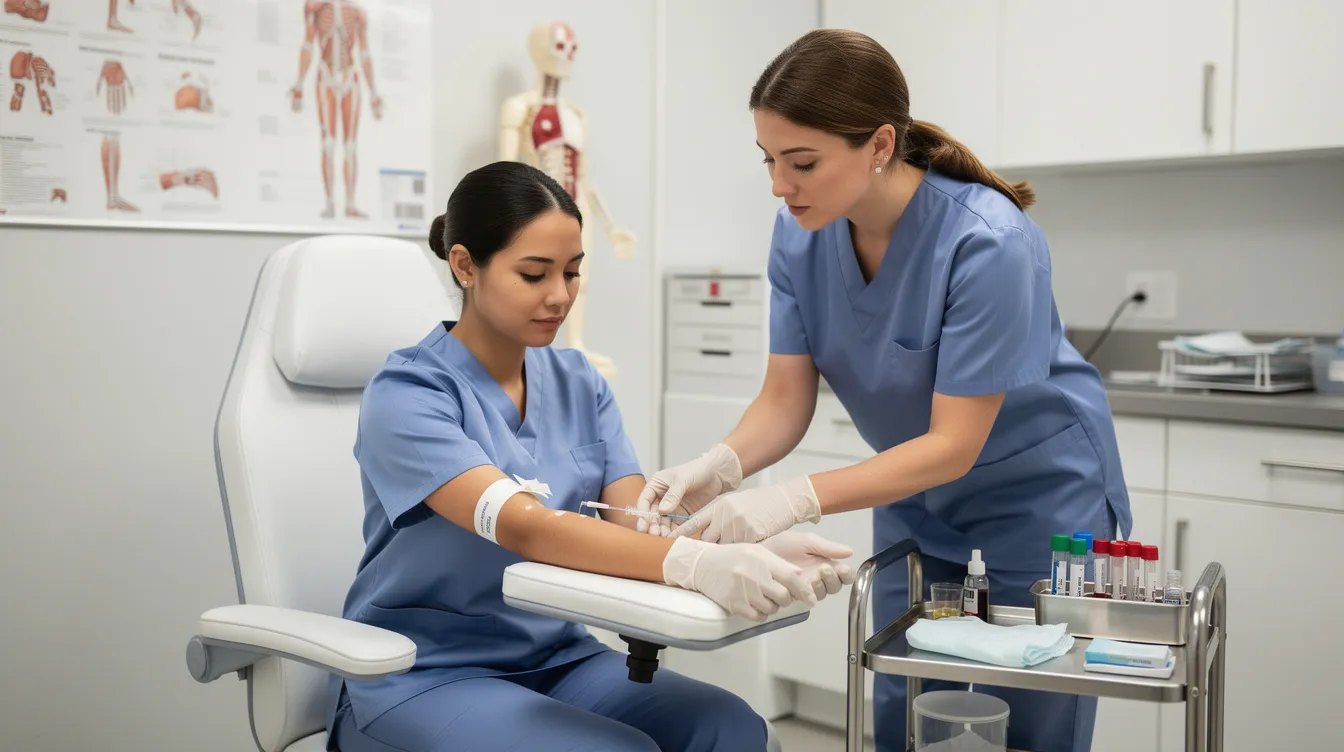
Clinical training turns theory into practice and is a key step in becoming phlebotomy certified.
- Most phlebotomy training programs require students to complete a minimum of 50 venipunctures and 10 skin punctures as part of their clinical training.
- To qualify for certification, candidates must complete at least 50 venipunctures and 10 skin punctures, along with observation of arterial punctures during their training.
- Students practice on simulation equipment before supervised clinical setting work.
- A clinical rotation may occur at an approved clinical site during weekday clinical hours.
- Candidates must apply to take a proctored exam from an accredited national agency after logging clinical hours.
Phlebotomy provides hands-on experience with patient interaction, safety protocols, and laboratory procedures, serving as a foundation for further medical careers.
Hybrid Schedule and Campus Locations Across Connecticut
Northeast Medical Institute delivers online lectures so students can study from home, then complete labs at locations across Connecticut. Northeast Medical Institute serves students near Stamford, New Haven/Woodbridge, Bridgeport-area communities, East Hartford, Middlebury/Waterbury, and additional statewide sites, and prospective students can review detailed directions to Northeast Medical Institute campuses.
Evening options may help working adults, although clinical hours often follow standard healthcare schedules. Contact Northeast Medical Institute for the current open enrollment calendar; not every course can begin anytime.
Application Process and Entry Requirements
The application process is straightforward:
- Submit the Northeast Medical Institute application.
- Upload ID and education documents.
- Complete any required assessment or admissions meeting.
- Submit health forms, Hepatitis B, MMR, Varicella, Tdap, TB testing, and flu documentation if required.
- Complete background check and drug screen if required by a clinical partner or hospital.
Seats are limited, especially for students using WIOA or other assistance, so explore available financial assistance for CNA, phlebotomy, or patient care training.
Documents You May Need for Your Phlebotomy Application
Checklist:
- government-issued photo ID
- proof of high school completion
- physical exam form
- immunization records
- TB test results
- background check and drug screen reports
- medical insurance information if requested by a clinical site
Keep copies for employers, certification, and renewal.
Certification Exams and Job Outlook
After completing Northeast Medical Institute’s phlebotomy program, graduates may sit for a certification exam such as NHA CPT. National certification improves hiring chances because most employers and states require national certification for phlebotomists to practice legally, and certified Phlebotomy Technicians generally earn higher starting wages and better benefits compared to uncertified peers.
According to the U.S. Bureau of Labor Statistics, the median annual wage for phlebotomists is $43,660, with certified professionals averaging $51,108 nationally. The Bureau of Labor Statistics also reports the average salary for a Phlebotomy Technician is over $35,500, with top earners making nearly $50,000 per year. In 2022, the average median salary for Phlebotomists in Massachusetts was reported to be $44,830.
Employment for phlebotomists is projected to grow 6% to 8% over the next decade according to the U.S. Bureau of Labor Statistics. The US Bureau of Labor Statistics (BLS) also previously forecast a 17% growth in the demand for Phlebotomists between now and 2029, much faster than average. Review current labor statistics through the BLS Occupational Outlook Handbook.
Phlebotomy credentials typically need to be renewed every two to three years, which requires completing 10 hours of Continuing Education credits.
Where Certified Phlebotomy Technicians Work in Connecticut
Certified phlebotomists can find employment in diagnostic laboratories, blood donation banks, outpatient care centers, hospitals, clinics, nursing homes, a doctor’s office, community health centers, and mobile services.
Schedules may include early morning draws, day shifts, evening shifts, or weekends. Northeast Medical Institute’s statewide presence helps students train close to home and connect with Connecticut’s healthcare system.
Why Choose Northeast Medical Institute?
Choose Northeast Medical Institute because:
- Northeast Medical Institute offers the only Hybrid Phlebotomy Tech Certification program in Connecticut.
- Northeast Medical Institute combines online learning with in-person practice statewide.
- Small labs give students more direct coaching.
- Faculty understand Connecticut clinical expectations.
- Programs connect to CNA, EKG, Patient Care Technician, Pharmacy Technician, CPR/BLS, and other pathways, and prospective students often review phlebotomy training questions and answers as they plan their route into healthcare.
- Funding options such as WIOA may help eligible students.
If a website form blocks you with a security service, message such as “cloudflare ray id found,” “cloudflare ray i,” “cloudflare ray,” “performed triggered,” “sql command,” “online attacks,” “malformed data,” or “certain word,” contact the site owner; it may be a security solution issue, not your eligibility.
FAQs About Becoming Phlebotomy Certified in Connecticut
How long does it take to become a certified phlebotomy technician at Northeast Medical Institute?
Most students complete the hybrid program in weeks to a few months, depending on schedule and clinical site availability.
Is the Northeast Medical Institute phlebotomy program suitable for someone working full-time?
Yes. The only hybrid phlebotomy tech certification in Connecticut is designed for working adults, but clinical hours may require daytime availability, and some choose nearby CNA and phlebotomy courses in New Haven to fit their schedules.
Do I need prior healthcare experience to enroll?
No. Many students are new to healthcare. CNA, medical assistant, or other healthcare experience can help, but it is not required, and some students gain experience through Certified Nurse Aide training classes in Stamford before or alongside phlebotomy.
Can I use my phlebotomy certificate outside Connecticut?
Often yes, because national certification is widely recognized. Always check the specific requirements in the state where you plan to work.
What financial assistance is available?
Short-term programs may not qualify for traditional federal aid, but Northeast Medical Institute may support eligible students through WIOA, payment options, and local workforce funding.
Ready to become phlebotomy certified? Contact Northeast Medical Institute to find the next hybrid cohort, nearest Connecticut campus, and your fastest path into healthcare.