

Pharmacy Technician Certifications: 2026 Guide for Connecticut Students
Key Takeaways
- The Certified Pharmacy Technician (CPhT) credential from the pharmacy technician certification board (PTCB) is the most recognized certification nationwide, accepted by hospitals, retail chains, and specialty pharmacies across Connecticut and beyond.
- As of 2026, the pharmacy technician certification exam (PTCE) is administered exclusively in person at Pearson VUE test centers – there is no at-home online testing option. The exam fee is $129, and candidates face 90 multiple choice questions within a two hours testing window.
- Candidates must complete a PTCB recognized education program or accumulate 500 hours of pharmacy technician work experience before applying, and a high school diploma or GED is required.
- Northeast Medical Institute’s Pharmacy Technician Training Program in Connecticut is designed to align with PTCB recognized program standards, preparing students to sit for the ptcb exam upon graduation.
- Certified pharmacy technicians must renew their credential every two years through continuing education, and Northeast Medical Institute helps graduates navigate CE planning and long-term career growth.
Introduction: What Is a Pharmacy Technician Certification?
Pharmacy technician certifications are nationally recognized credentials that verify a technician’s competency in medication dispensing, patient safety, federal pharmacy law, and day-to-day pharmacy operations. The most widely held credential is the CPhT, issued by PTCB after a candidate passes the pharmacy technician exam known as the PTCE. There are two main certifications recognized nationally for pharmacy technicians – the PTCB’s CPhT and the ExCPT – though the CPhT dominates employer preference.
In Connecticut, working as a pharmacy technician requires registration with the Department of Consumer Protection, but that state registration is separate from national certification. Many employers in hospital, retail, and long-term care pharmacy settings strongly prefer or require nationally certified pharmacy technicians, even when state law does not mandate it. Holding both state registration and national certification positions you for higher pay, expanded responsibilities, and a more rewarding career.
Northeast Medical Institute in Connecticut offers a focused Pharmacy Technician Training Program built to prepare students for the PTCB credential exams, covering everything from drug classification and pharmacy law to hands-on dispensing skills for effective patient care.
Types of Pharmacy Technician Credentials and Exams
Pharmacy technicians can pursue several types of credentials, but entry-level students should focus first on earning the CPhT. This section breaks down what’s available.
Certified Pharmacy Technician (CPhT) via PTCB
The CPhT certification from the pharmacy technician certification board is the industry standard. Major employers – hospitals, health systems, CVS, Walgreens – either require or strongly prefer it. Candidates must pass a national exam as part of the certification process, and the credential requires renewal every two years with approved continuing education hours.
ExCPT Certification
The ExCPT Certified Pharmacy Technician is a respected alternative certification administered by the National Healthcareer Association (NHA). It tends to be more retail-oriented and is accepted by many employers, though it carries less universal recognition than the CPhT, particularly in institutional pharmacy settings.
Assessment-Based Certificates
PTCB also offers specialized certificates in areas like non hazardous and sterile compounding, immunization administration, and billing. These:
- Do not typically require renewal
- Do not carry post-nominal letters
- Build on a baseline CPhT credential for career advancement
This article focuses on the initial cpht certification process, but experienced technicians can layer on specialized credentials later.

PTCB CPhT Eligibility Requirements (Updated 2026)
PTCB eligibility requirements can change, so always confirm details on the official PTCB website before applying. Here are the core eligibility requirements for 2026:
- Education: A high school diploma or GED is required to become a pharmacy technician.
- Training or experience: Candidates must complete a PTCB recognized program or have 500 hours of pharmacy tech experience. The 500 hours of pharmacy work experience must be completed by application time.
- Residency: Candidates must reside in the United States or its territories.
- Background disclosure: Candidates must disclose all criminal history to PTCB and must pass a background check for pharmacy technician certification. Full disclosure is essential – omissions can result in denial.
Northeast Medical Institute’s training program is designed to align with ptcb recognized education standards, helping students satisfy the education pathway without needing 500 hours of work experience first.
Proper identification is critical. Your legal name, government-issued ID, and personal details must match exactly across your application, ptcb account, and the ID you bring on exam day.
For testing accommodations candidates with disabilities or medical conditions, start documentation early and submit requests during the application process – not at the last minute.
How to Apply and Register: Application Process for the PTCB Exam
The application process is straightforward once you know what to expect. Here is a step-by-step walkthrough:
Step 1: Create a PTCB Account
- Create a PTCB account at ptcb.org. Enter your personal details, education history, and either your PTCB recognized education program completion or 500 hours of work experience documentation.
Step 2: Submit Your Application
- Submit your application with the required exam fee of $129. Provide evidence of program completion – graduates of Northeast Medical Institute can upload their certificate of completion.
Step 3: Wait for Approval
- Wait for approval. Once your application approved status is confirmed, you will receive an Authorization to Schedule your exam, typically valid for 90 days.
Step 4: Schedule Your Exam
- Schedule your exam through Pearson VUE’s website or phone line. Choose a local Connecticut test center, select a date and time, and review policies around exam cancellation or rescheduling.
The application fee for the PTCB exam is $129 – budget for this separately from tuition. Students enrolled at Northeast Medical Institute may also explore WIOA funding or local workforce programs to help cover training program costs.
Schedule your exam strategically so your test day falls shortly after completing coursework and review sessions. Cpht candidates who test within weeks of finishing their program tend to retain more material.
Exam Format, Content Domains, and What to Expect on Exam Day
Exam Format
The ptce exam consists of 90 multiple-choice questions delivered on a computer at a Pearson VUE center. Eighty questions are scored while ten are unscored. Those unscored questions are randomly distributed throughout the exam, so treat every question equally. Candidates have two hours to complete the PTCE, plus additional time for a Pearson tutorial (about ten minutes) and a post exam survey.
Content Domains
The exam covers four knowledge domains with these approximate 2026 weightings:
- Medications (drug classes, allergies indications, adverse effects, medications drug stability, expiration dates, sig codes, top 200 drugs): ~35%
- Patient Safety and Quality Assurance (medication safety, error prevention): ~23.75%
- Order Entry and Processing (prescription intake, data entry, insurance): ~22.50%
- Federal Requirements (controlled substances, DEA/FDA rules, DSCSA): ~18.75%
Federal requirements coverage has increased in recent years, so students should devote serious study time to controlled substance schedules and supply chain regulations.
Exam Day Logistics
- Arrive at the test center at least 30 minutes early.
- Bring acceptable government-issued ID matching the name on your ptcb account. Failure to present proper identification can result in denial of entry.
- Personal items go into lockers; the center provides scratch materials and a system test before you begin.
- Pharmacists and other test-takers share the same quiet testing environment, so expect a structured testing experience.
Online Testing, Scheduling Changes, and Exam Cancellation Policies
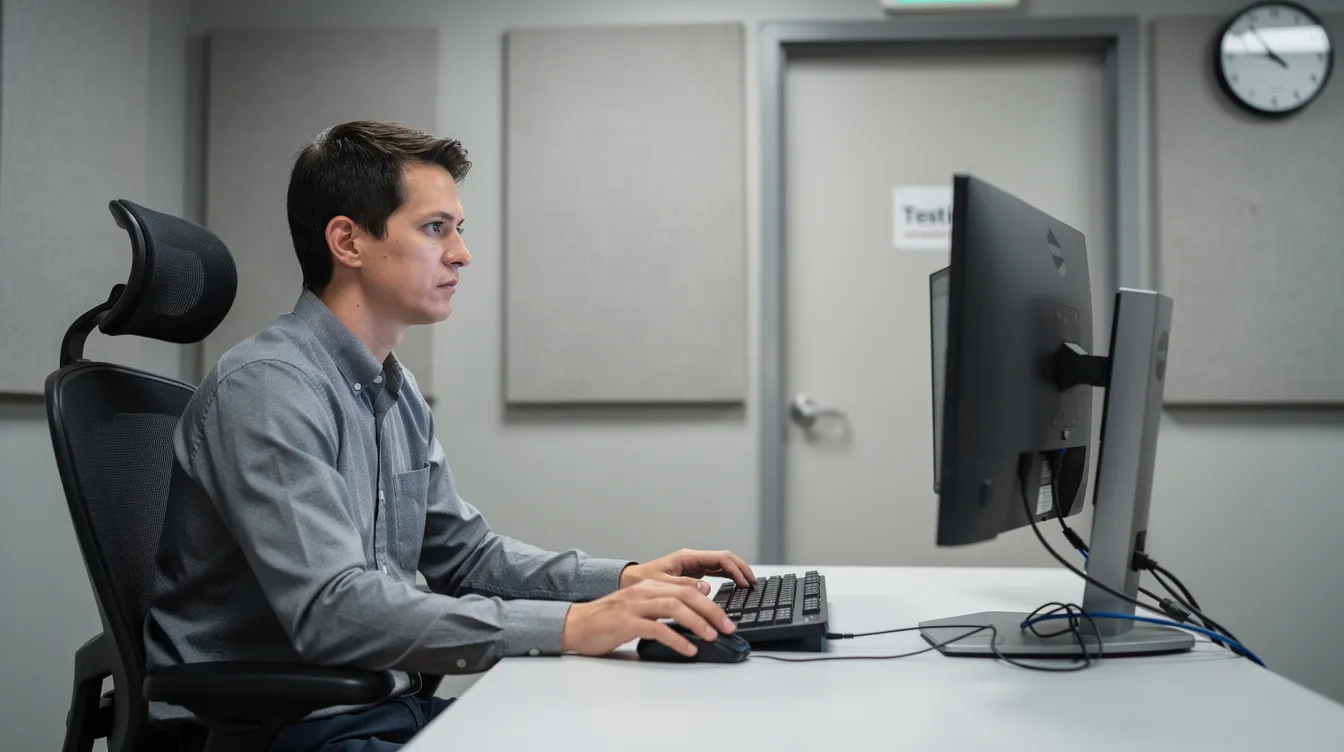
Many students search for ptcb exam online options, but as of late 2025 and into 2026, PTCB has discontinued remote online proctored testing. The exam is administered exclusively in-person at pearson vue test centers – no exceptions for the core CPhT credential.
While you cannot take the exam online from home, you can manage scheduling online through Pearson VUE’s portal. The actual credential exams, however, require physical presence. The phrase “exam online” in some PTCB materials refers to the computer-based delivery within the secure test center environment, not at-home access.
Exam cancellation and rescheduling rules to know:
- Typically at least 24 hours’ notice is required to reschedule without forfeiting fees.
- Missed appointments or same-day cancellations usually mean forfeiture of your payment and a need to reapply.
- Failure to meet ID requirements or arrive on time for test day can be treated as a no-show with no refund.
Northeast Medical Institute students should coordinate exam scheduling with their instructors so the ptcb test date aligns with course completion and review sessions. A well-timed schedule reduces stress and maximizes readiness.
Scoring, Retakes, and Maintaining Your Certified Pharmacy Technician Status
Scoring and Results
The PTCE uses a scaled scoring system. Raw scores convert to a scale ranging from 1000 to 1600, with a passing score of 1400 or higher required to earn your CPhT. PTCB uses the modified angoff method to adjust the difficulty threshold across different test forms, so the exact number of correct answers needed varies. Only 80 out of 90 questions on the PTCE are scored – the ten unscored questions are pre-test items that do not affect your final score.
Results timeline:
- Unofficial pass or fail results appear on screen immediately after you finish and complete the post exam survey at the Pearson VUE test center.
- Official score reports with detailed domain breakdowns are posted to your PTCB account within approximately one to three weeks.
Retake Policies
- Candidates can retake the PTCE after 60 days for the first two attempts.
- A longer waiting period applies for a third attempt.
- After failing four times, candidates must provide evidence of additional test prep (such as completing a study course or passing practice tests) before being approved to sit again.
Maintaining Your Credential
Pharmacy technicians must renew their national certification every two years and complete continuing education hours – typically 20 CE hours per cycle, covering topics like patient safety, quality assurance, pharmacy law updates, and medications. Letting your certification lapse limits your career options significantly.
Northeast Medical Institute helps graduates understand CE requirements, locate affordable resources, and plan for recertification well before their credential’s expiration.
How Northeast Medical Institute Prepares You for National Certification
Northeast Medical Institute is a Connecticut-based vocational school specializing in short-term, hands-on healthcare training – including Pharmacy Technician, CNA, Phlebotomy, EKG Technician, PCT, and CPR courses that are featured across its healthcare training programs.
The Pharmacy Technician Training Program covers:
- Classroom and lab instruction aligned with PTCE content domains – medications, federal requirements, order entry, and medication safety
- Drug classification and pharmacy law, as part of NEMI’s comprehensive curriculum that also includes a certified phlebotomy technician course
- Potential hybrid or evening schedules for working students, supported by experienced NEMI faculty and leadership
Exam prep is built into the program:
- Practice tests that mirror ptcb credential exams to help identify weak areas in your knowledge
- Top 200 drug lists, math drills, and flashcards to memorize pharmacy vocabulary effectively, supplemented for some students by resources used in NEMI’s phlebotomy training course
- Study guides approved by PTCB, providing up-to-date information aligned with the 2026 content outline
- Structured approach to keep students on track, with most candidates spending 4 to 12 weeks preparing for the PTCE
Support extends beyond coursework. NEMI staff assist with the PTCB application process, guidance on exam scheduling at nearby Pearson VUE centers, and exploring funding such as WIOA or other local workforce programs, including free CNA training options in Connecticut.
Graduates step into entry-level pharmacy technician roles in Connecticut pharmacy settings – retail, hospital, specialty, and long-term care – meeting both state board and employer expectations for certified pharmacy personnel across diverse pharmacy settings.

FAQ: Pharmacy Technician Certifications and the PTCB Exam
How long does it take to become a certified pharmacy technician in Connecticut?
A typical timeline includes a few months to complete Northeast Medical Institute’s Pharmacy Technician Training Program, followed by 4 to 12 weeks of focused PTCB exam preparation, and then scheduling the PTCE at a nearby Pearson VUE center. Many students achieve ptcb certification within six to nine months total. The time limit depends on your study pace and scheduling availability.
Is national certification required to work as a pharmacy technician in every state?
Requirements vary by state. State licensing bodies regulate pharmacy technician practice based on unique regulations. In Connecticut, to become a pharmacy technician, registration with the Department of Consumer Protection is required, but national certification is not legally mandated. However, holding a CPhT certification enhances job applications and opportunities, and many hospital and chain pharmacies in Connecticut strongly prefer or require it. State pharmacy technician licensure requires application through the state’s Board of Pharmacy in states where licensure applies.
What is the difference between PTCB and other pharmacy technician certification exams?
The PTCB’s PTCE is the most widely accepted pharmacy technician certification exam, especially among hospitals and large chains. The ExCPT exam, administered by the National Healthcareer Association (NHA), is a respected alternative that tends to be more retail-focused. Northeast Medical Institute primarily prepares students for the PTCB because of its broader employer acceptance across pharmacy settings.
Can I work while I’m studying for the PTCB credential exam?
Yes. Many students hold part-time jobs – sometimes as pharmacy technician trainees gaining experience in approved pharmacy settings – while enrolled at Northeast Medical Institute. Balancing work and study is manageable with a structured schedule. Use practice tests to target weak areas, study flashcards during breaks, and block dedicated review sessions each week.
What happens if I let my certified pharmacy technician credential expire?
If a CPhT fails to complete required continuing education and renew on time, their certification becomes inactive. This can limit job opportunities significantly, especially in institutional or specialty pharmacy roles. Depending on how long the credential has lapsed, you may need to pay a reinstatement fee, submit CE proof, or in some cases retake the credential exam entirely. Northeast Medical Institute offers a PTCB-recognized online Pharmacy Technician Training Program that prepares students thoroughly for certification and helps them maintain their credentials through guidance on continuing education and recertification requirements.